...A man who embodied the spirit of Kinshasa, Africa's third-largest city and a byword in some minds for urban chaos, but also a creative melting pot unrivalled in its day on the continent.
Papa Wemba was known abroad for bringing Congo's lilting rumbas into the global arena after blending them with frenetic guitar riffs and his own hauntingly high tenor. At home he was much more than a singer. Among other things he was the original "mikilist". Mokili means "the world" in Lingala — which for its lyrical expressiveness is the Italian of African languages. Mikili means Europe or the west. And mikilists were the Congolese who had "arrived", so to speak, in Paris, Brussels or London. There is a utopian element to the concept that has driven millions of young Congolese abroad in search of greener pastures and earnings to remit home. For much of the time that Papa Wemba was strutting the stage, almost anywhere could seem a greener pasture than Zaire, as Congo was formerly called.
His band, Viva la Musica, was the first to tour Europe in the early 1980s, when Zaire was on the brink of a long-drawn-out implosion that rumbles on like so many tropical thunderclouds to this day. He had made it in Kinshasa in the 1970s with his original formation, Zaiko Langa Langa. This took the languid, Cuban-inspired rumbas of the 1960s, stripped out the wind section and speeded up the rhythm, and with it the way people danced. Thus he pioneered soukous. Paris became a base and he began to make it in Europe — the king of mikilists.
On his returns to Kinshasa in the 1980s, he and his friend Colonel Jagger (named after the aforementioned Mick) brought with them a dress sense that set off another defining Congolese trend, the "Société des Ambianceurs et Personnes Elégantes" (Sape). This prescribed among young and impoverished Congolese the wearing of the latest Parisian chic. It was a way of maintaining self-esteem amid the economic hardships of the time and also a rebellion against the repressive Mobutu regime's ban on western clothes.
Underlying the fad was yet another uniquely Kinshasa concept, forged in the turmoil and decline that defined much of Mobutu Sese Seko's 32-year dictatorship: Article 15. This refers to an imagined clause in the national constitution amounting to "débrouillez-vous", or "help yourself because no one else will". By dressing beyond your means, you also established your status as an Article 15 talent.
For much of his career before it was attained, material success was suggested by the designer clothes that Papa Wemba wore. And that was a big part of his charisma. He had immense self-belief and was always ahead of the game.
...
Congo has long been a state in no more than name. But the Congolese have a national identity stronger than many more functional African nations, nurtured in large part by the country's music. Papa Wemba not only wrote much of that soundtrack. He also organised the costume department.
So while mourning Prince, who died just three days before, spare a thought for the king of Congolese rumba. He sold fewer records. But he probably swung more hips. William Wallis is the FT's African affairs writer
The Brazilian Bus Magnate Who’s Buying Up All the World’s Vinyl Records
Freitas
is a wealthy businessman who, since he was a child, has been unable to
stop buying records. ‘I’ve gone to therapy for 40 years to try to
explain this to myself.’
By MONTE REEL
Paul
Mawhinney, a former music-store owner in Pittsburgh, spent more than 40
years amassing a collection of some three million LPs and 45s, many of
them bargain-bin rejects that had been thoroughly forgotten. The world’s
indifference, he believed, made even the most neglected records
precious: music that hadn’t been transferred to digital files would
vanish forever unless someone bought his collection and preserved it.
Mawhinney
spent about two decades trying to find someone who agreed. He struck a
deal for $28.5 million in the late 1990s with the Internet retailer
CDNow, he says, but the sale of his collection fell through when the
dot-com bubble started to quiver. He contacted the Library of Congress,
but negotiations fizzled. In 2008 he auctioned the collection on eBay
for $3,002,150, but the winning bidder turned out to be an unsuspecting
Irishman who said his account had been hacked.
Then last year, a friend of Mawhinney’s pointed him toward a classified ad in the back of Billboard magazine:
RECORD COLLECTIONS. We BUY any record collection. Any style of music. We pay HIGHER prices than anyone else.
That
fall, eight empty semitrailers, each 53 feet long, arrived outside
Mawhinney’s warehouse in Pittsburgh. The convoy left, heavy with vinyl.
Mawhinney never met the buyer.
“I don’t know a thing about him — nothing,” Mawhinney told me. “I just know all the records were shipped to Brazil.”
Just
weeks before, Murray Gershenz, one of the most celebrated collectors on
the West Coast and owner of the Music Man Murray record store in Los
Angeles, died at 91. For years, he, too, had been shopping his
collection around, hoping it might end up in a museum or a public
library. “That hasn’t worked out,” The Los Angeles Times reported in
2010, “so his next stop could be the Dumpster.” But in his final months,
Gershenz agreed to sell his entire collection to an anonymous buyer. “A
man came in with money, enough money,” his son, Irving, told The New
York Times. “And it seemed like he was going to give it a good home.”
Those
records, too, were shipped to Brazil. So were the inventories of
several iconic music stores, including Colony Records, that glorious
mess of LP bins and sheet-music racks that was a Times Square landmark
for 64 years. The store closed its doors for good in the fall of 2012,
but every single record left in the building — about 200,000 in all —
ended up with a single collector, a man driven to get his hands on all
the records in the world.
In an office
near the back of his 25,000-square-foot warehouse in São Paolo, Zero
Freitas, 62, slipped into a chair, grabbed one of the LPs stacked on a
table and examined its track list. He wore wire-rimmed glasses, khaki
shorts and a Hard Rock Cafe T-shirt; his gray hair was thin on top but
curled along his collar in the back. Studying the song list, he appeared
vaguely professorial. In truth, Freitas is a wealthy businessman who,
since he was a child, has been unable to stop buying records. “I’ve gone
to therapy for 40 years to try to explain this to myself,” he said.
His
compulsion to buy records, he says, is tied up in childhood memories: a
hi-fi stereo his father bought when Freitas was 5 and the 200 albums
the seller threw in as part of the deal. Freitas was an adolescent in
December 1964 when he bought his first record, a new release: “Roberto
Carlos Sings to the Children,” by a singer who would go on to become one
of Brazil’s most popular recording stars. By the time he finished high
school, Freitas owned roughly 3,000 records.
After
studying music composition in college, he took over the family
business, a private bus line that serves the São Paulo suburbs. By age
30, he had about 30,000 records. About 10 years later, his bus company
expanded, making him rich. Not long after that, he split up with his
wife, and the pace of his buying exploded. “Maybe it’s because I was
alone,” Freitas said. “I don’t know.” He soon had a collection in the
six figures; his best guess at a current total is several million
albums.
Recently,
Freitas hired a dozen college interns to help him bring some logic to
his obsession. In the warehouse office, seven of them were busy at
individual workstations; one reached into a crate of LPs marked “PW
#1,425” and fished out a record. She removed the disc from its sleeve
and cleaned the vinyl with a soft cloth before handing the album to the
young man next to her. He ducked into a black-curtained booth and
snapped a picture of the cover. Eventually the record made its way
through the assembly line of interns, and its information was logged
into a computer database. An intern typed the name of the artist (the
Animals), the title (“Animalism”), year of release (1966), record label
(MGM) and — referencing the tag on the crate the record was pulled from —
noted that it once belonged to Paulette Weiss, a New York music critic
whose collection of 4,000 albums Freitas recently purchased.
For the truly compulsive hobbyist, there comes a time when a collection gathers weight — metaphysical, existential weight.
The
interns can collectively catalog about 500 records per day — a
Sisyphean rate, as it happens, because Freitas has been burying them
with new acquisitions. Between June and November of last year, more than
a dozen 40-foot-long shipping containers arrived, each holding more
than 100,000 newly purchased records. Though the warehouse was
originally the home of his second business — a company that provides
sound and lighting systems for rock concerts and other big events —
these days the sound boards and light booms are far outnumbered by the
vinyl.
Many
of the records come from a team of international scouts Freitas employs
to negotiate his deals. They’re scattered across the globe — New York,
Mexico City, South Africa, Nigeria, Cairo. The brassy jazz the interns
were listening to on the office turntable was from his man in Havana,
who so far has shipped him about 100,000 Cuban albums — close to
everything ever recorded there, Freitas estimated. He and the interns
joke that the island is rising in the Caribbean because of all the
weight Freitas has hauled away.
Allan
Bastos, who for years has served as Freitas’s New York buyer, was
visiting São Paulo and joined us that afternoon in the warehouse office.
Bastos, a Brazilian who studied business at the University of Michigan,
used to collect records himself, often posting them for sale on eBay.
In 2006, he noticed that a single buyer — Freitas — was snapping up
virtually every record he listed. He has been buying records for him
ever since, focusing on U.S. collections. He has purchased stockpiles
from aging record executives and retired music critics, as well as from
the occasional celebrity (he bought the record collection of Bob Hope
from his daughter about 10 years after Hope died). This summer Bastos
moved to Paris, where he’ll buy European records for Freitas.
Bastos looked over the shoulder of an intern, who was entering the information from another album into the computer.
“This will take years and years,” Bastos said of the cataloging effort. “Probably 20 years, I guess.”
Twenty years — if Freitas stops buying records.
Collecting has always
been a solitary pursuit for Freitas, and one he keeps to himself. When
he bought the remaining stock of the legendary Modern Sound record store
in Rio de Janeiro a couple of years ago, a Brazilian newspaper reported
that the buyer was a Japanese collector — an identity Bastos invented
to protect Freitas’s anonymity. His collection hasn’t been publicized,
even within Brazil. Few of his fellow vinyl enthusiasts are aware of the
extent of his holdings, partly because Freitas never listed any of his
records for sale.
But
in 2012, Bob George, a music archivist in New York, traveled with
Bastos to São Paulo to prepare for Brazilian World Music Day, a
celebration that George organized, and together they visited Freitas’s
home and warehouse; the breadth of the collection astonished George. He
was reminded of William Randolph Hearst, the newspaper magnate who
lusted after seemingly every piece of art on the world market and then
kept expanding his private castle to house all of it.
“What’s the good of having it,” George remembers telling Freitas, “if you can’t do something with it or share it?”
The
question nagged at Freitas. For the truly compulsive hobbyist, there
comes a time when a collection gathers weight — metaphysical,
existential weight. It becomes as much a source of anxiety as of joy.
Freitas in recent years had become increasingly attracted to mystic
traditions — Jewish, Christian, Hindu, Buddhist. In his house, he and
his second wife created a meditation room, and they began taking
spiritual vacations to India and Egypt. But the teachings he admired
didn’t always jibe with his life as a collector — acquiring, possessing,
never letting go. Every new record he bought seemed to whisper in his
ear: What, ultimately, do you want to do with all this stuff?
He
found a possible model in George, who in 1985 converted his private
collection of some 47,000 records into a publicly accessible resource
called the ARChive of Contemporary Music. That collection has grown to
include roughly 2.2 million tapes, records and compact discs.
Musicologists, record companies and filmmakers regularly consult the
nonprofit archive seeking hard-to-find songs. In 2009 George entered
into a partnership with Columbia University, and his archive has
attracted support from many musicians, who donate recordings, money or
both. The Rolling Stones guitarist Keith Richards has provided funding
for the archive’s collection of early blues recordings. David Bowie,
Paul Simon, Nile Rodgers, Martin Scorsese and Jonathan Demme all sit on
its board.
Freitas
has recently begun preparing his warehouse for his own venture, which
he has dubbed Emporium Musical. Last year, he got federal authorization
to import used records — an activity that hadn’t been explicitly allowed
by Brazilian trade officials until now. Once the archive is registered
as a nonprofit, Freitas will shift his collection over to the Emporium.
Eventually he envisions it as a sort of library, with listening stations
set up among the thousands of shelves. If he has duplicate copies of
records, patrons will be able to check out copies to take home.
Some
of those records are highly valuable. In Freitas’s living room, a
coffee table was covered with recently acquired rarities. On top of a
stack of 45s sat “Barbie,” a 1962 single by Kenny and the Cadets, a
short-lived group featuring the Beach Boys’ Brian Wilson on lead vocals
and, as backup singers, Wilson’s brother Carl and their mother, Audree.
In the same stack was another single — “Heartache Souvenirs"/"Chicken
Shack,” by William Powell — that has fetched as much as $5,000 on eBay.
Nearby sat a Cuban album by Ivette Hernandez, a pianist who left Cuba
after Fidel Castro took power; Hernandez’s likeness on the cover was
emblazoned with a bold black stamp that read, in Spanish, “Traitor to
the Cuban Revolution.”
While
Freitas thumbed through those records, Bastos was warning of a future
in which some music might disappear unnoticed. Most of the American and
British records Freitas has collected have already been digitally
preserved. But in countries like Brazil, Cuba and Nigeria, Bastos
estimated, up to 80 percent of recorded music from the mid-20th century
has never been transferred. In many places, he said, vinyl is it, and
it’s increasingly hard to find. Freitas slumped, then covered his face
with his hands and emitted a low, rumbling groan. “It’s very important
to save this,” he said. “Very important.”
Freitas
is negotiating a deal to purchase and digitize thousands of Brazilian
78 r.p.m. recordings, many of which date to the early 1900s, and he
expects to digitize some of the rarest records in his collection shortly
thereafter. But he said he could more effectively save the music by
protecting the existing vinyl originals in a secure, fireproof facility.
“Vinyl is very durable,” he said. “If you store them vertically, out of
the sun, in a temperature-controlled environment, they can pretty much
last forever. They aren’t like compact discs, which are actually very
fragile.”
In
his quest to save obscure music, Bastos told me, Freitas sometimes buys
records he doesn’t realize he already owns. This spring he finally
acquiesced to Bastos’s pleas to sell some of his duplicate records,
which make up as much as 30 percent of his total collection, online.
“I said, ‘Come on, you have 10 copies of the same album — let’s sell four or five!’ ” Bastos said.
Freitas
smiled and shrugged. “Yes, but all of those 10 copies are different,”
he countered. Then he chuckled, as if recognizing how illogical his
position might sound.
Freitas and the interns joke that the island is rising in the Caribbean because of all the weight he has hauled away.
In
March, he began boxing up 10,000 copies of Brazilian LPs to send to
George in an exchange between the emerging public archive and its
inspirational model. It was a modest first step, but significant.
Freitas had begun to let go.
Earlier this year,
Freitas and Bastos stopped into Eric Discos, a used-record store in São
Paulo that Freitas frequents. “I put some things aside for you,” the
owner, Eric Crauford, told him. The men walked next door, where Crauford
lives. Hundreds of records and dozens of CDs teetered in precarious
stacks — jazz, heavy metal, pop, easy listening — all for Freitas.
Sometimes
Freitas seems ashamed of his own eclecticism. “A real collector,” he
told me, is someone who targets specific records, or sticks to a
particular genre. But Freitas hates to filter his purchases. Bastos once
stumbled upon an appealing collection that came with 15,000 polka
albums. He called Freitas to see if it was a deal breaker. “Zero was
asking me about specific polka artists, whether they were in the
collection or not,” Bastos remembered. “He has this amazing knowledge of
every kind of music.”
That
afternoon, Freitas purchased Crauford’s selections without inspecting
them, as he always does. He told Crauford he’d send someone later in the
week to pick them up and deliver them to his house. Bastos listened to
the exchange without comment but noted the destination of the records —
Freitas’s residence, not the archive’s warehouse. He was worried that
the collector’s compulsions might be getting in the way of the archiving
efforts. “Zero isn’t taking too many of the records to his house, is
he?” Bastos had asked a woman who helps Freitas manage his cataloging
operation.
No,
she told him. But almost every time Freitas picked up a record at the
archive, he’d tell a whole story about it. Often, she said, he’d become
overwhelmed with emotion. “It’s like he almost cries with every record
he sees,” she told him.
Freitas’s
desire to own all the music in the world is clearly tangled up in
something that, even after all these years, remains tender and raw.
Maybe it’s the nostalgia triggered by the songs on that first Roberto
Carlos album he bought, or perhaps it stretches back to the 200 albums
his parents kept when he was small — a microcollection that was damaged
in a flood long ago but that, as an adult, he painstakingly recreated,
album by album.
After
the trip to Eric Discos, I descended into Freitas’s basement, where he
keeps a few thousand cherry-picked records, a private stash he doesn’t
share with the archive. Aside from a little area reserved for a
half-assembled drum kit, a couple of guitars, keyboards and amps, the
room was a labyrinth of floor-to-ceiling shelving units filled with
records.
He
walked deep into an aisle in search of the first LP he ever bought, the
1964 Roberto Carlos record. He pulled it from the shelf, turning it
slowly in his hands, staring at the cover as if it were an irreplaceable
artifact — as if he did not, in fact, own 1,793 additional copies of
albums by Roberto Carlos, the artist who always has, and always will,
occupy more space in his collection than anyone else.
Nearby
sat a box of records he hadn’t shelved yet. They came from the
collection of a man named Paulo Santos, a Brazilian jazz critic and D.J.
who lived in Washington during the 1950s and who was friendly with some
of the giants of jazz and modern classical music. Freitas thumbed
through one album after another — Duke Ellington, Ella Fitzgerald,
Leonard Bernstein, Dave Brubeck. The records were signed, and not with
simple autographs; the artists had written affectionate messages to
Santos, a man they obviously respected.
“These dedications are so personal,” Freitas said, almost whispering.
He
held the Ellington record for an extended moment, reading the
inscription, then scanning the liner notes. Behind his glasses, his eyes
looked slightly red and watery, as if something was irritating them.
Dust, maybe. But the record was perfectly clean.
Six Iranians have been arrested by police after posting a version of Pharrell Williams' hit song Happy on YouTube.
The amateur video shows three young men and three unveiled women dancing to the tune on Tehran's streets and rooftops.
"We have made this video as Pharrell Williams' Fans in 8 hours, with
iPhone 5S. "Happy" was an excuse to be happy. We enjoyed every second of
making it. Hope it puts a smile on your face," reads a message for the
video, titled Happy We are from Tehran, at the end.
This man also dances in the video
But the group were detained when the video, which has been viewed
thousands of times, came to the attention of Tehran's police force.
Police chief Hossein Sajedinia was quoted by the ISNA news agency as
saying: "After a vulgar clip which hurt public chastity was released in
cyberspace, police decided to identify those involved in making that
clip.
"Following a series of intelligence and police operations
and after coordinating with the judiciary, all the suspects were
identified and arrested."
ISNA said the detainees had "confessed to their criminal acts".
Pharrell Williams' song is from the film Despicable Me 2
Williams, whose song from the film Despicable Me 2 has been one of the
biggest hits of the year, commented on the arrests on Twitter.
He wrote: "It's beyond sad these kids were arrested for trying to spread happiness."
Conservatives say many young Iranians are abandoning Islamic values and turning to a more Western way of life.
Under Islamic law, in force in Iran since the 1979 revolution, women must cover themselves from head to toe.
More than a decade ago a "morality police" unit was formed to verify that women scrupulously respect the dress code in public.
The internet is also heavily filtered in Iran, with the authorities blocking access to popular social networking sites.
Civil liberties and women's rights have returned to the forefront since President Hassan Rohani's election last June.
A moderate, he had campaigned for greater cultural and social freedoms
in the Islamic republic, specifically urging police tolerance over the
veil.
Richard Branson reviews The Rolling Stones - Red Room - Virgin.com
"note on my ticket while @officialKeef played riff from ‘Paint It Black’: F**kin’ Great!"
Eric Clapton, playing a blinder on ‘Champagne & Reefer’
“This could be the last time,” sang Mick Jagger as the Rolling Stones played yet another rock ‘n’ roll classic. Let’s hope this isn’t the last time the world’s greatest band get together onstage.
From start to finish the Rolling Stones gig at the o2 Arena was sheer magic. It was strange being there to see them live so many years after I had first seen the band play together. The best concert I ever saw was the Stones in Hyde Park, but this ran it pretty close! From the thrilling production to the high-octane set, it was a five-star performance.
With demand for tickets so high, we were very privileged to be present as Mick, Keef, Charlie, Ronnie and the gang put on their masterclass. Everyone present knew it and the atmosphere was electric. Though it was all-seated, nobody sat down during the entire set. In fact, when I went so take a seat for a moment I promptly fell flat on my arse – only reinforcing the fact that we should carry on standing up dancing!
Many dismiss older people as being past it and not having as much to offer as youngsters. However, the Rolling Stones are just as talented and exciting as they were when they were 20. If anything their musicianship has improved over the years and there is a special chemistry between the band that is irreplaceable. Despite all of their disagreements over the years, they rise above their differences to make something great.
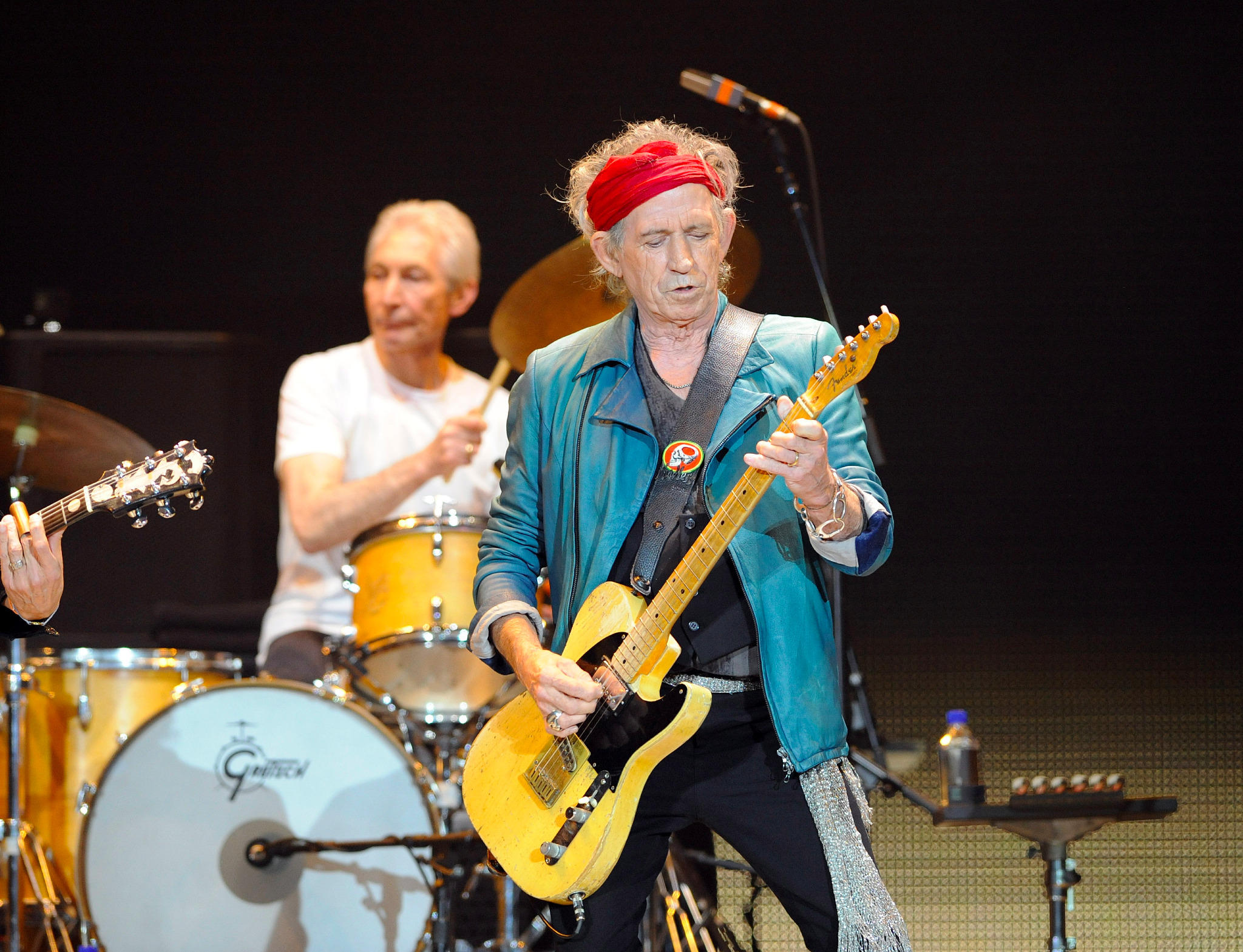
Keith Richards is such a character, the real rogue of rock ‘n’ roll, but his guitar playing is still out of this world. He’s in great shape considering what he has put his body through. Somebody should dissect him (not yet of course!) It was great to see the former Stones members Bill Wyman and Mick Taylor join them onstage too. I remember seeing Mick as a beautiful young man performing with Mike Oldfield on his Tubular Bells show at Queen Elizabeth Hall. What a talent.
There were also special guests from the old and new schools of music, with Slowhand himself, Eric Clapton, playing a blinder on ‘Champagne & Reefer’ and Florence Welch showing off her lung-busting vocals on an incendiary ‘Gimme Shelter’.
As for the song of the night? There’s so many to choose from, all the way from ‘You Can’t Always Get What You Want’ to ‘Start Me Up’, ‘Satisfaction’ to ‘Sympathy For The Devil’. Perhaps my scribbled note on my ticket while Keef played riff from ‘Paint It Black’ sums the gig up best: F**kin’ Great!
Alpha Blondy et Tiken Jah Fakoly, les frères ennemis du reggae ivoirien, ont fait la paix. Le président Ouattara leur a donné pour mission de montrer l’exemple.
L’un est le père du reggae ivoirien ; l’autre, celui qui lui a donné un nouveau souffle. Le premier a soutenu Laurent Gbagbo avant de s’en détourner pendant la crise postélectorale, tandis que le second s’est exilé au Mali voisin peu après sa prise de pouvoir. Mais ce sont surtout leurs divergences personnelles qui opposaient les deux icônes du reggae ivoirien, Alpha Blondy (58 ans, à g.) et Tiken Jah Fakoly (43 ans). « Des tentatives de réconciliation, on en a fait plusieurs, témoigne un ami commun. Chaque fois ça échouait, sans qu’on sache pourquoi. »
C’est Alassane Ouattara en personne qui a mis un terme aux dissensions entre le « Marley ivoirien » et l’« enfant de Gbéléban ». Les rencontrant l’un après l’autre en mai à Paris, le chef de l’État leur a demandé de travailler ensemble à la réconciliation des Ivoiriens. Comment dire non au président ? Ni une ni deux, les protagonistes de la guéguerre du reggae s’affichent tout sourire devant les photographes et sont désormais à tu et à toi.
Pour sceller leur nouvelle amitié, ils préparent même ensemble une caravane de la paix et de la réconciliation pour la fin de l’année. À défaut de se rencontrer – Alpha Blondy vit plus à Paris qu’à Abidjan, Tiken Jah Fakoly, à Bamako –, ils se parlent régulièrement pour faire le point sur l’organisation et tentent, chacun de leur côté, de rallier les artistes pro-Gbagbo exilés dans la sous-région et en Europe. D’abord dépités par la fin de la rivalité, les fans de chaque camp ont fini par s’en réjouir : ils pourront, pour la première fois, voir les deux idoles sur la même scène.
Published: September 30 2010 18:01 | Last updated: September 30 2010 18:01
Most musicians are known for a particular sound, style or song. But not rock guitar legend Jeff Beck, who says the secret of his staying power has been the ability to “move on to something else”. It’s a journey that has taken him – via rock, heavy metal, jazz and soul – to his current world tour, backed by a full string orchestra.
“I’m at home with anything that’s got a groove to it,” says the ex-Yardbirds guitarist, pointing to a DVD he is making in tribute to legendary guitarist Les Paul and 1950s jazz. “I get just as much of a kick from that as I do coming up with something from tomorrow-land.”
But Beck’s taste for experimentation does not stretch to his finances – something in which he claims to have no interest but just a little “intuition”. He was almost persuaded to buy a portfolio of shares just before the financial crisis; luckily, he decided at the last minute not to sign. “It was a near-miss for me. But I said no, because I wasn’t satisfied with – or didn’t understand – what was being proposed. When people talk bank-talk, I glaze over after five minutes,” he admits.
Beck now uses the London-based private bank Duncan Lawrie, mainly because it offers a reassuringly old-fashioned experience. Lamenting the passing of the days when “you could almost have a pint with your local bank manager”, he remembers how he and his former concert manager grew frustrated with the impersonal service and “incompetence” of their high street bank. After doing research, manager settled on Duncan Lawrie and suggested Beck switch too.
“I felt nervous at first, because I didn’t really know whether I was making the right decision. But I’ve no complaints. It’s so important to have a one-to-one talk with someone at your bank. They’re handling your money, after all. You go around the world and make your money, and you want to be sure it’s being looked after.”
Beck is currently on the second leg of his world tour. He is still basking in the success of his latest album, Emotion & Commotion, which was released in April and is now up for eight Grammys. He says it is the best response that he has received since 1975, when he teamed up with Beatles producer George Martin to make the album Blow by Blow.
Fans have been particularly struck by Beck’s lush use of strings as backing for his electric guitar. “There’s no substitute for a full string orchestra,” he explains. “I was fulfilling a dream – I wanted to do it back in 1966, but couldn’t afford it. I was always impressed by people like Tina Turner and the way that kind of record was produced. It’s a beautiful sound that can only be achieved with acoustic instruments.”
Beck is also pleased with the popularity of Emotion & Commotion because singers, not instrumentalists, tend to dominate the charts. The guitarist has been wary of working too closely with singers ever since he parted ways with Rod Stewart – then the unknown lead singer of his up-and-coming band the Jeff Beck Group – back in 1969.
“Rod was a bit of a problem because his name wasn’t on the ticket, and the whole ego thing kicked off. I said if you put your name on the ticket you won’t sell any seats, but he wasn’t happy being treated as a sideman,” Beck laughs.
Stewart left to join the group the Faces, which seemed a career upset for Beck, but turned out to be liberating. “The singer problem was gone when Rod left. Rather than see that as negative, I thought: the doors are open.” He says it was working with the New York jazz-rock group Mahavishnu Orchestra in the mid-1970s that made him realise there was “life after singers”.
Beck considers the US his second home. He cites American rock and roll, blues and jazz as his original creative sources, and the US still gives him the warmest reception. It was there he spent a year in tax exile in 1977, which ironically was to pay for his English home – an Elizabethan manor house in the Sussex Weald that he fell in love with on first viewing.
“It was complete lunacy, as I didn’t know if I had the money. But when the estate agents opened the door I just wanted them gone,” he reminisces, grateful that his home turned out to be a good investment too.
Beck struggles to single out one highlight of his career, which has spanned four and a half decades and at least 10 different groups. “The big highlight is that I’m still in the business,” he says with another raucous laugh.
Copyright The Financial Times Limited 2010. Print a single copy of this article for personal use. Contact us if you wish to print more to distribute to others.
By Paul Morley FT.com
Published: September 3 2010 21:59 | Last updated: September 3 2010 21:59
David Bowie on stage in Rotterdam in 1976, the year he made ‘Station to Station’
How much do you like David Bowie? You will have to like him a lot to want to spend more than £80 on a deluxe box set edition of his 10th studio album Station to Station (1976), an ostentatious souvenir collection of memorabilia, outtakes, live concerts, photography, essays, remastered versions, exclusive mixes and heavyweight vinyl inspired by the mere six tracks that made up the original record.
It is a mesmerising album, one of Bowie’s best, which is saying something, as he made many, most of them during the 1970s, that were sold as entertainment but contained the moving detail and mysterious, transformative depth of art.
It may well be one of rock’s very greatest, as a comment both on where the smart, neurotic artist who made it was, psychologically, creatively and commercially, but also where rock music itself was, on its compelling journey from Sinatra, Presley and the Beatles to Prince, Jay-Z and Gaga, from the Velvet Underground, the Kinks and Kraftwerk to Madonna, Nirvana and Nine Inch Nails. It is one of those Bowie albums, like Hunky Dory(1971), or Ziggy Stardust(1972), or Low (1977), or Lodger (1979), that are at times my favourite of his, because they demonstrate with such elan what a sparkling, mischievous mind he had, and what ambition, and what a stupendous ego, and how dangerously charming he was.
His impact as a musician, as a brand, as a sign of the times, has been as great as Dylan and the Beatles, his influence as an otherworldly pop star actually greater, and if you just want one example of what he got up to as this erudite pop combination of shaman, singer, thinker and shameless self-promoter, then Station to Station is as good a place as any. But is all of that worth £80? And does wrapping it up inside such technological and geeky paraphernalia clarify its position as a musical masterpiece, or turn it into a banal collector’s item, a nicely designed object of desire for committed Bowie fetishists and connoisseurs?
There’s no obvious anniversary marking the release of the deluxe edition. It’s a non-special 34 years since Station to Station was produced, coming between the Americanised soul-funk slickness of his Young Americans (1975) album and the radiant, challenging Euro-bleakness of Low. He was working on Nic Roeg’s dark film fable The Man Who Fell to Earth(1976). Peter O’Toole was not available to play Thomas Jerome Newton, an exiled visitor from outer space, a role that seemed perfect for the lost, distracted, preternaturally bright Bowie. Station to Station was a soundtrack that never was to the film as Bowie was strangely not asked to compose the movie’s music. Roeg just wanted the cracked, emaciated Bowie that was falling apart in real life, the wired, burnt-out pop star playing the baffled but brilliant spaceman from the future, part new-born innocent, part ancient guru.
Playing an alien, and having lost sight of his real self after years of relentless shapeshifting, Bowie constructed a new character, the Thin White Duke. Inside six years, since 1970, he’d been a psychedelic music hall singer channelling Syd Barrett and Anthony Newley, a whimsical novelty specialist, surreal folkie, risqué glam rock starman, cosmic wizard, apocalyptic androgynous Diamond Dog and blanked-out white soul man flirting with superstardom. Now, he would play a transparently autobiographical, ghostly, narcissistic, cocaine obsessed, existential adventurer, anxiously yearning for deeper meaning in a superficial, chilling world.
Bowie would kill off the damaged, demented Thin White Duke a little quicker than he killed off Ziggy Stardust, just in case the Duke took over like Ziggy appeared to. The soundtrack to this character showed Bowie withdrawing from his fascination with the expressive, penetrating showmanship of American soul and turning to more enigmatic and forward looking European music. Young Americans, containing hits such as “Fame” and an appearance by John Lennon, was the calculatedly commercial Bowie response to achieving the American fame he had set his heart on. He was becoming so successful he was peering into some form of the middle of the road, a fixed place Bowie wasn’t quite ready for. Station to Station – feeling hunted, he was moving from place to place, character to character, fixation to fixation, charade to charade – was where he faced his demons, and made a kind of baroque soul music where it is not quite clear if there is soul involved. It retains the iced funk and post disco groove of Young Americans, alongside decaying traces of the kinky folk, metal, glam, and cabaret melodrama he’d passed through in the early 1970s. But it was already anticipating his less obviously commercial next destination, abstract and minimalist European electronic music. Station to Station contains echoes of everything Bowie had done, or was about to do. Previous characters re-dream themselves. It becomes the link, the tunnel, through which Bowie crawled – spent, emptied out – from fraying pop star decadence to the three classic made in Berlin albums he released next. On Low, Heroes (1977) and Lodger, Bowie and close collaborators Brian Eno and Tony Visconti created a stark, pulsating post-pop soundtrack to personal and historical tensions where Bowie broke out into the wider spaces of the universe. On this trilogy, Bowie refrained from entering the worlds himself, and losing himself in all the offbeat theatre. Station to Station was where he recovered himself, or at least enough of himself that he could continue his search for new extremes, and new experiences, and the kind of unusual, unforced new pop music he craved, music that produced worlds all of his own. . . .
Depending on your age, you might already have bought a few versions of Station to Station. First of all, pretty much on the day it came out, the original RCA vinyl disc, released when the deliciously unstable Bowie dominated the pop planet in a way that makes Gaga, Beyoncé, Florence and co seem a little lightweight. Then, a few years later, the CD version, and then perhaps, depending how much you loved Bowie, a remastered CD version, even a Japanese import. Or two.
The original 1976 cover
Digging through my record cupboard, preparing the space for the big box of Station to Station, I find I have the vinyl version, with original black and white cover, and the bright orange RCA label that induces Proustian pangs of feeling for those days when a male teenager could fall in love with Bowie because he seemed so alive, and so scandalously full of himself. I’ve also got a CD version bought at full price, and then one bought for less than a fiver when I thought I’d lost the first one. The music business survived well into the 1990s following a policy of blind greed persuading people to buy albums they already owned all over again on CD. Now, perhaps at the end of its tether, devastated by the arrival of such alternative music sources as iTunes, the music industry is hoping to persuade people to buy once more in a gorgeous new format the same thing yet again, still relying on its back catalogues for sustenance. Or, depending on your point of view, ensuring that in a world where music can be so easily distributed through the air, the album can still exist in tempting solid form, as a tangible thing, something that you can hold, not merely store, and place in a sterile list of your favourite music.
The vinyl version is something that I have clearly held a lot, and loved, and still love, prized like a hardback first edition, now looking strangely oversized and florid in a world where even the miniaturised CD has been replaced by essentially the featureless, soulless, click-click nothing of the download. The CD versions look less powerful, more paperback, and more clinical.
Somehow, an old collection of music that could recently be bought for a few pounds, on the verge of being something you could get on tap, is now on sale, admittedly smartly done up, for almost £90. This is a lavish way of pointing out that a big part of the appeal of a pop record in the last few years of the vinyl era was the combination of the music and the art, the image, the design – the overall story, a constantly developing context – that went with it.
It calls into question just what is going to happen to all those albums that have been made and that artistically deserve to endure now that the era of this kind of vinyl-shaped album is more or less over. What was an album, what is Station to Station, how will we remember it? As a complete, significant work, as a series of loosely connected songs that will just randomly flow off into space and time, separated from each other, available on demand until they just fade away into silence, or some kind of work of art that needs to be celebrated and dissected in this way?
It seems right that David Bowie is at the forefront of such consideration of how vinyl era music – songs and stardom that existed because of the nature of the 45rpm single and the 33⅓ album – will survive this new period in music. He may not have been especially active for the past 20 years or so but he’s never stopped thinking, and plotting, and fastidiously nurturing his image.
After making his extraordinary albums in the 1970s, and inevitably running out of energy in the 1980s, he then settled down into his reputation, his history, with a knowing, Dylan-like acceptance, and an occasional Dylan-like reminder of his unique powers. He wasn’t as aloof and inscrutable as Dylan, but had his own ways of protecting, and projecting, his mystique. In Bowie’s case, this meant not just an occasional good new album, or a memorable tour. It also meant a strategic understanding of how entertainment itself was changing because of the technological progression that meant there would be more and more music, less and less originality, and newer ways of receiving and playing that music. He ended his formal alliances with record labels at the beginning of the century, set himself up as web location, turned himself into a sort of bank, and in 1997 sold his future royalties to the Prudential Insurance Company as Bowie Bonds, leading some wags to suggest he invented derivatives and was directly responsible for the latest recession. A confirmed futurist, he anticipated a breakdown in music industry and media certainties, and prepared himself for the science fiction future he always craved. A future where his 20th-century music could still exist, and still sound contemporary.
Albums such as Station to Station are from the past. Boxing them up in expensive deluxe editions is essentially a commercially based nostalgic act, extending their life as product, to some extent one last mad music industry fling. But the music itself, six songs, expertly weaving their enchanting phantom spell, from the opening title track, an extended montage of despair and determination, lunacy and sorrow, to the final track, a precious, caressing version of “Wild is the Wind” first sung in 1957 by Johnny Mathis, where Bowie appears to repair his self-control, via the tricky, nervily jaunty big hit “Golden Years”, is thus given yet another lease of life. The music is strong and intriguing enough to resist the vulgarisation of being repackaged and resold one more time. Somehow, the ornate deluxe edition of Station to Station says: the album is dead, long live the album.
.................................................. From Ziggy Stardust to SpongeBob SquarePants 1947 David Robert Jones born January 8 in Brixton, south London. Shares same birthday as Elvis Presley. 1953 Family moves to Kent. Attends Bromley Technical High School where Peter Frampton, later a rock guitarist, is a friend. 1961 Fight with friend leaves one pupil severely dilated, causing illusion his eyes are different colours. 1963 Leaves school with art O-level. Becomes junior paste-up artist at ad agency. 1964 First release, under the name of Davie Jones, is “Liza Jane/Louie Louie Go Home”. Interviewed on TV as founder of Society for the Prevention of Cruelty to Long-haired Men, he complains, “It’s not nice when people call you darling and that.” 1966 Changes name to Bowie to avoid clash with Davy Jones of the Monkees. 1967First solo album, David Bowie, an odd, jolly mix of pop and psychedelia. 1969 “Space Oddity”, song set in outer space, released to coincide with moon landing 1970 Marries Mary Angela (Angie) Barnett for whom the Rolling Stones song “Angie” was written. Begins unequalled run of 11 studio albums from Man Who Sold The World (1970) to Scary Monsters (1980). 1972 First appearance of glam group Ziggy Stardust and the Spiders from Mars. Produces Lou Reed’s Transformer. 1973 Breaks up Ziggy Stardust and the Spiders From Mars. 1975 Re-release of “Space Oddity” is first UK number one. 1977 Bing Crosby records “The Little Drummer Boy”, with Bowie, a month before crooner’s death. Appears on old friend Marc Bolan’s ITV music show, duetting on “Heroes”. Bolan dies in car crash two days later. 1980 “Ashes to Ashes” is second UK number one. 1981 “Under Pressure”, with Queen, is third number one.
In ‘The Man Who Fell To Earth’ (1976)
1983 Releases Let’s Dance, produced by Nile Rodgers; title track fourth number one 1985 Having won praise as actor in films The Man Who Fell To Earth (1976), The Hunger (1983), Merry Christmas, Mr Lawrence (1983) and on Broadway in The Elephant Man in 1980, turns down role in Bond film A View to a Kill. Duet with Mick Jagger on “Dancing in the Streets” leads to fifth number one. 1989 Forms Tin Machine. Critics sneer, live album does not chart. 1992 Marries Iman Abdul Majid in Switzerland. 1996 Plays Andy Warhol in Julian Schnabel’s Basquiat. 1997 Releases internet-only single “Telling Lies”. Predicts time when music will be freely available at click of a switch. Sells back catalogue for $55m, creating Bowie Bonds, planning to pay back money from future royalties. 2003 Declines knighthood. 2004 Suffers heart attack, undergoes triple bypass. 2006 Receives lifetime award at Grammys. 2007 Voices Lord Royal Highness on TV cartoon SpongeBob SquarePants. 2010 Lady Gaga says Bowie is her biggest influence and she wants to work with him


 ©AFP/Getty Images


 wishing I was there!!!


